
Fake Oxy Pills (M30s): How Fentanyl Is Driving Overdoses
Fake M30 "blue" pills often contain lethal fentanyl. Learn how teens get them, the warning signs, and the prevention steps that can save a life.

If your teen has ever mentioned blues, M30s, or Perc 30s, this article is for you. Not to scare you, but to make sure you have the facts that could matter most.
Here is what parents in Florida and across the country need to know right now: the fentanyl crisis is real, it is showing up in pills that look completely legitimate, and the rates of use/overdoses are declining. But the threat has not gone away, and one pill can still be enough to cause a fatality.
What Are M30 Pills, and Why Are They So Dangerous?
M30 is a legitimate prescription oxycodone tablet, a small blue pill stamped with an M on one side and 30 on the other, prescribed by doctors for moderate to severe pain. For years it was a recognizable, regulated medication.
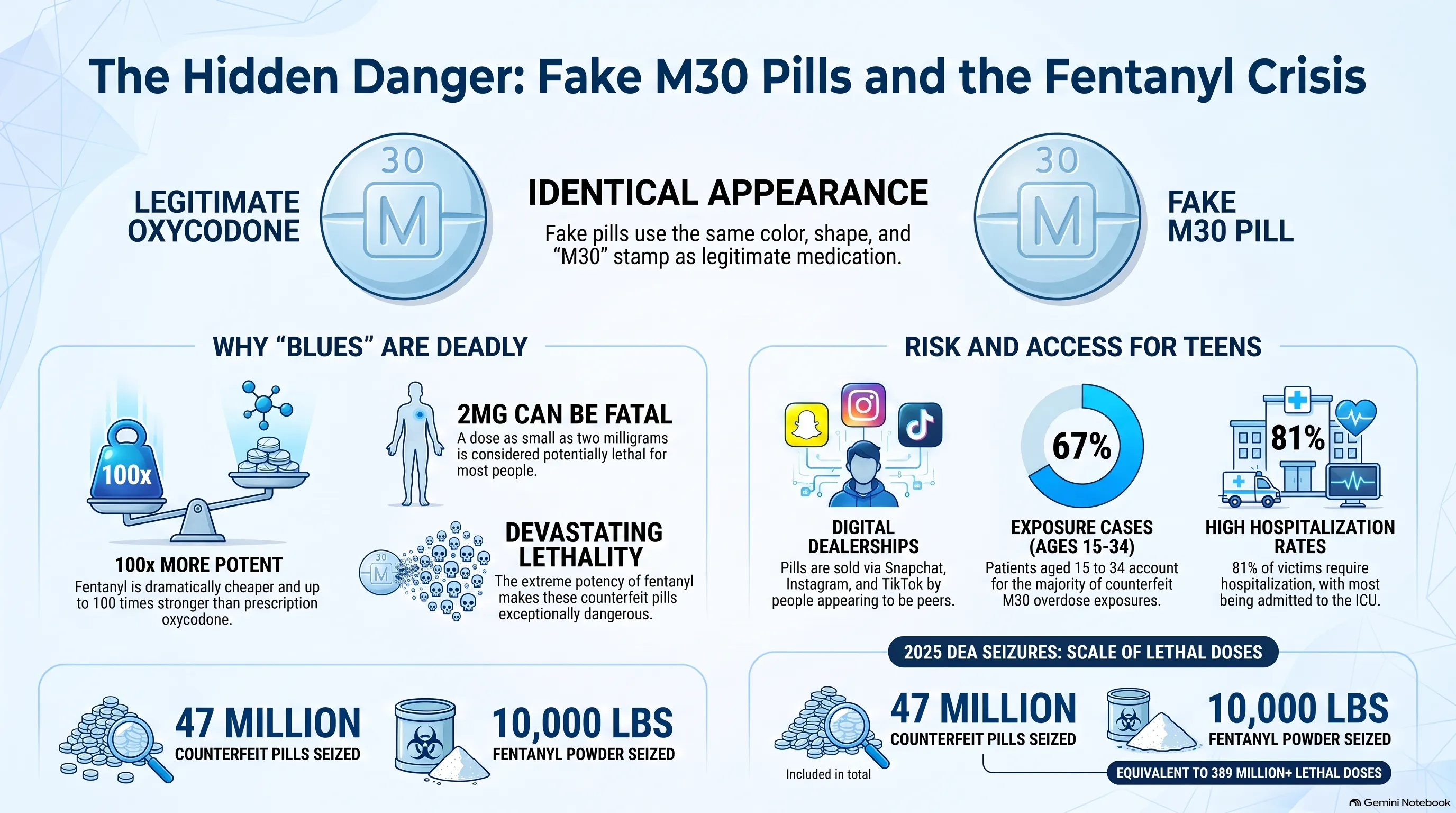
Fake M30 pills are now mass-produced in illegal labs, primarily using fentanyl instead of oxycodone. Fentanyl is dramatically cheaper to produce and up to 100 times more potent than oxycodone by weight [1]. The fake pills are designed to be visually the same as the real thing. Same color, shape, and stampings. A teenager who thinks they are taking a painkiller to get high, or even just to try it once, may have no way of knowing what they actually have.
In 2025, the DEA seized more than 47 million fentanyl-laced counterfeit pills and nearly 10,000 pounds of fentanyl powder, the equivalent of over 369 million lethal doses [1]. According to the DEA, the average counterfeit M30 pill contained 1.94 milligrams of fentanyl, but individual pills ranged widely, and a dose as small as 2 milligrams is considered potentially lethal for someone without opioid tolerance [1].
How Are Teens Getting These Pills?
Teens are not typically getting fake M30s from a dealer on a street corner. They are getting them through social media platforms and apps, Snapchat, Instagram, TikTok, and Telegram, from people who look like peers and who present the transaction as completely normal [2].
They might get them from a friend who got them from someone else, which creates a false sense of safety. They are not buying from a stranger. They are getting something from someone they trust, who got it from someone they trusted, and nobody in that chain knows what is actually in the pill.
Patients aged 15 to 34 accounted for 67% of counterfeit M30 overdose exposure cases in one CDC study, and 81% of those patients required hospitalization, with more than two thirds admitted to the ICU [3].
Is the Fentanyl Crisis Getting Better?
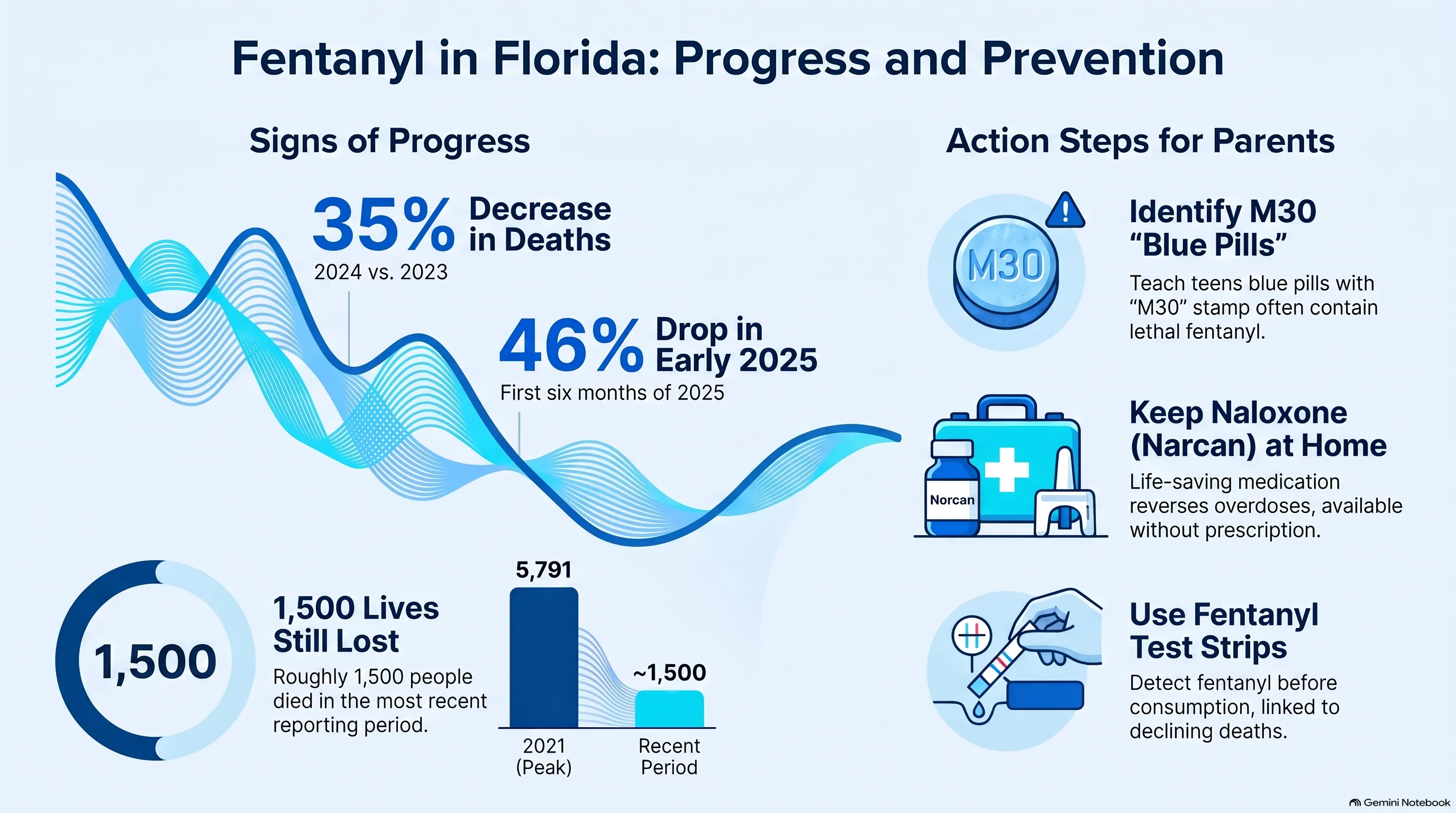
Yes, in Florida, the numbers have come down significantly. Fentanyl-caused deaths in Florida fell by 35% in 2024 compared to 2023, and by 46% in the first half of 2025 compared to the same period the year before [4] [5].
Florida's fentanyl crisis peaked in 2021 at 5,791 deaths. Even with the recent declines, roughly 1,500 people in Florida still died from fentanyl in the most recent reporting period [4].
The risk of picking up a pill that contains a lethal dose has not disappeared. And for a teenager who takes one pill believing it is something else, statistics about declining trends don't offer comfort to grieving parents.
What Parents Can Actually Do
Explain what M30s look like and where they come from. Teens who know that a blue pill with an M30 stamp could contain a lethal dose of fentanyl are more equipped to make a different decision than teens who have never heard that fact. Knowledge is not permission. It is protection.
Have naloxone (Narcan) at home. Naloxone is a medication that reverses opioid overdoses and can be the difference between life and death in the minutes before emergency services arrive. In Florida, it is available without a prescription at most pharmacies. Having it at home does not send a message that you expect your teen to use drugs. It sends a message that you are the kind of parent who is prepared.
Know about fentanyl test strips. Fentanyl test strips can detect the presence of fentanyl in a substance before it is consumed. They are a harm reduction tool, not an endorsement of drug use. In Florida, their use has been associated with the recent decline in overdose deaths [4].
Watch for warning signs. Changes in friend groups, unexplained mood shifts, drowsiness, small pinpoint pupils, and withdrawal from family are all worth paying attention to. If something feels off, trust that.
What If You Think Your Teen Is Already Using?
Teen substance use is treatable, and the earlier it is addressed, the better the outcomes. At Lotus Behavioral Health in Winter Springs, Florida, we specialize in teen mental health and addiction treatment for young people ages 12 to 17.
Our programs include residential treatment, partial hospitalization, intensive outpatient, and telehealth options, and we work with most major insurance plans including Blue Cross Blue Shield, Cigna, Optum, TriCare, UnitedHealthcare, Humana, Aetna, and Bright Health.
Our admissions team is available now to answer your questions and verify your insurance, at no cost and with no pressure.

Sources:
[1] Biology Insights. (2026). What are M30 pills? Real vs. counterfeit explained. Biology Insights.
[2] Multnomah County. (2026). Two teens die from overdose of suspected counterfeit pills containing fentanyl. Multnomah County.
[3] Centers for Disease Control and Prevention. (2024). Suspected counterfeit M-30 oxycodone pill exposures and acute withdrawals reported from a single hospital. MMWR, 73(29).
[4] WUSF Public Media. (2026). Florida's drug overdose deaths continue to decline in 2025. WUSF.
[5] KFF. (2026). Opioid overdose deaths: National trends and variation by demographics and states. KFF Health News.
About the Author




.svg)



Hours
Accreditations


.png)