
How Sexual Trauma Increases the Risk of Substance Use in Adolescents
Sexual trauma triples a teen's risk of substance misuse. Learn the signs trauma may be underneath, and what trauma-informed treatment actually looks like.
.webp)
If something feels off with your teenager and you are starting to wonder whether there is more beneath the surface than a substance use problem, this article is for you. Sexual trauma and substance use are more closely linked than most people realize, and understanding that connection is often the first step toward getting a teen the right kind of help.
This is not about alarming you. It is about giving you the clearest possible picture of what may be driving what you are seeing and what actually works.
Why Sexual Trauma and Substance Use So Often Appear Together
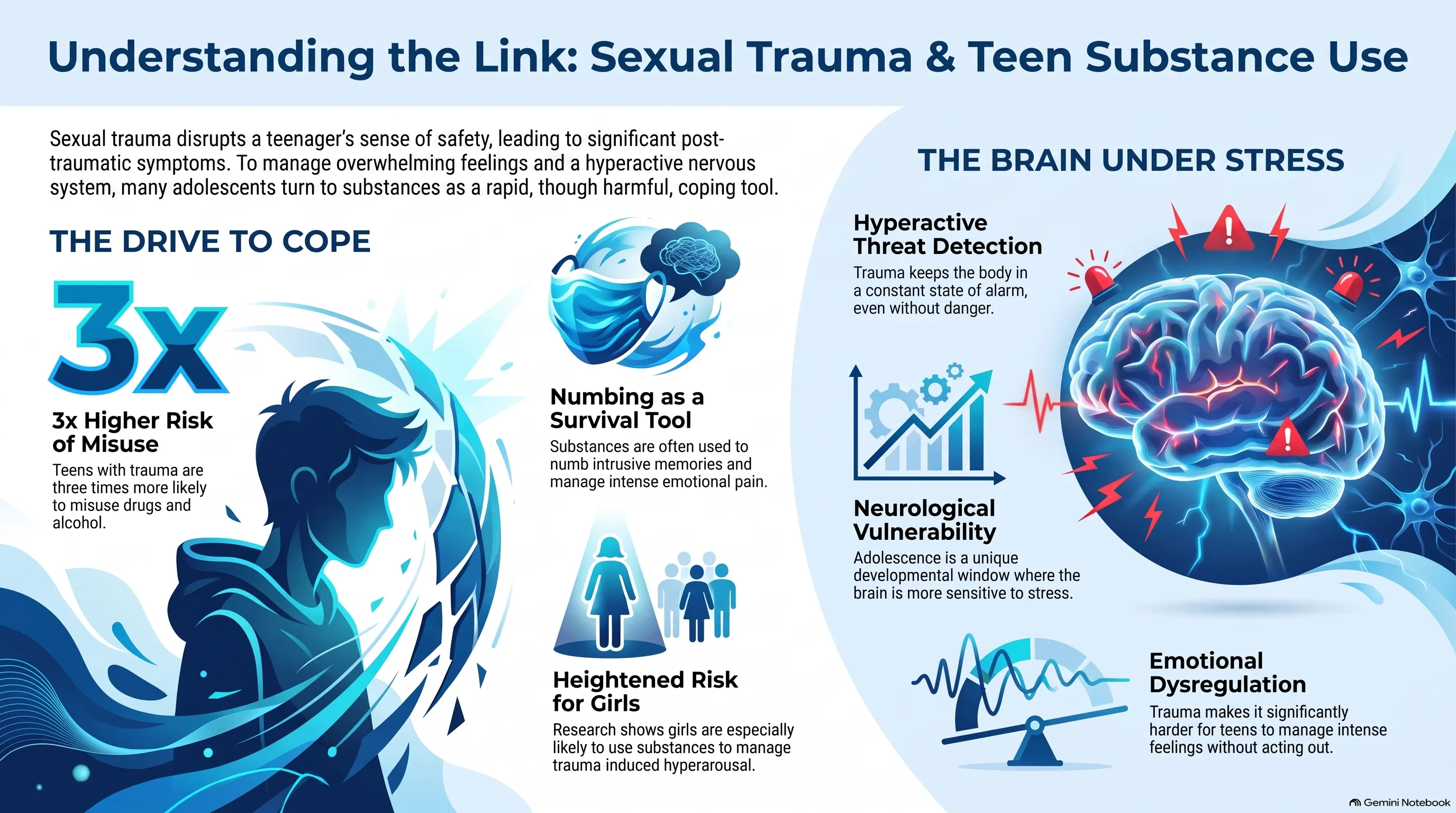
The link between sexual trauma and substance use in adolescents is one of the most consistently documented findings in youth mental health research. Teens who have experienced trauma are up to three times more likely to misuse drugs and alcohol compared to their peers [1]. And among all types of trauma, sexual trauma produces the most significant post-traumatic symptoms in children and teens [2].
Sexual trauma tells the nervous system that the world is not safe, that the body is not safe, and that the people who were supposed to provide protection either could not or did not. A teenager carrying that information does not necessarily have language for it. They may not even have conscious access to it. What they do have is an overwhelming need to feel better, safer, and less present in their own skin, and drugs or alcohol are often the fastest available answer to that need [3].
What Is Actually Happening in the Body and Brain
After sexual trauma, the brain's threat detection system becomes hyperactive. The body stays in a state of low-grade alarm even when there is no present danger. Sleep is disrupted. Concentration becomes difficult. Emotional regulation, the ability to manage intense feelings without acting on them, becomes significantly harder [4].
Adolescence is already a period of significant neurological development when the brain is more sensitive to stress and more vulnerable to the effects of substances. When trauma is layered on top of that developmental window, the combination creates conditions where substance use can take hold quickly and escalate faster than it might in an adult [5].
For teenage girls in particular, the research is clear. Girls who have experienced sexual trauma are significantly more likely to use substances as a coping mechanism, using alcohol, cannabis, or other drugs to numb feelings, avoid intrusive memories, and manage the hyperarousal that trauma leaves behind [6].
This does not mean boys are unaffected. It means that for girls, the pathway from sexual trauma to substance use is especially well-documented and important to understand.
Signs That Trauma May Be Underneath the Substance Use
If your teenager is using substances, these are signs that sexual trauma could be part of the picture:
- Significant changes in behavior, withdrawal, or personality following a specific period or event
- Avoidance of people, places, or situations that were previously normal
- Difficulty sleeping, nightmares, or a marked change in sleep patterns
- Heightened startle response, irritability, or what looks like ongoing anxiety
- Disconnection from the body, described as feeling numb, empty, or not real
- Reluctance to discuss certain relationships, events, or time periods
- Substance use that escalated quickly or that seems not caused by peer influence alone
None of these signs confirm that sexual trauma occurred. But they are indicators that something needs clinical attention and that the approach needs to account for the possibility of trauma rather than treating the substance use in isolation.
What Treatment Looks Like When Trauma Is Part of the Picture
Trauma-informed adolescent treatment means a clinical team that understands the connection between what happened and what is happening now.
It means creating an environment where a teenager feels safe enough to eventually begin processing the experience, because that processing cannot happen in a setting that replicates the conditions of threat [7].
Evidence-based approaches for teens navigating both sexual trauma and substance use include:
Trauma-Focused Cognitive Behavioral Therapy (TF-CBT): A structured, evidence-based therapy that helps young people gradually process traumatic memories, challenge distorted beliefs formed after trauma, and build coping skills. Family members are actively involved, which strengthens the relational safety a teen needs to heal.
Dialectical Behavior Therapy (DBT): Focuses on emotional regulation, distress tolerance, and interpersonal skills, giving teens concrete tools to manage overwhelming feelings without turning to substances.
Eye Movement Desensitization and Reprocessing (EMDR): A therapy that uses guided eye movements or tapping to help the brain reprocess traumatic memories so they lose their emotional charge over time. Particularly effective for teens whose trauma symptoms have not responded to talk therapy alone.
Somatic and Experiential Therapies: Because trauma lives in the body as much as the mind, approaches like somatic therapy, equine therapy, art therapy, and movement-based therapies help teens process what words cannot always reach. These therapies are especially valuable for young people who struggle to verbalize their experiences after sexual trauma.
Family-Based Models: Recovery does not happen in isolation. Family therapy strengthens communication, rebuilds trust, and creates the relational safety that makes a teenager's healing possible beyond the treatment setting.
_11zon.webp)
Trauma-Sensitive Drug and Alcohol Treatment: A Place of Safety and Refuge for Teens in Florida
At Lotus Behavioral Health in Winter Springs, Florida, we specialize in mental health and substance use treatment for teens ages 12 to 17. We understand that most teens who come to us with a substance use problem are carrying something else underneath it, and our clinical team is trained to meet that complexity with the care and sensitivity it deserves.
Our trauma-informed programs include residential treatment, partial hospitalization, intensive outpatient, and telehealth, and our approach integrates trauma processing with substance use treatment from the beginning. Family is central to how we work, because we know that a teen's healing is inseparable from the safety of their most important relationships.
If you know or believe your teenager may have experienced sexual trauma, and if you are seeing signs of substance use alongside it, please reach out. You do not have to have all the answers before you call. Our admissions team will help you figure out the next right step.

Sources
[1] Behavioral Health News. (2025). Understanding the link between trauma and substance use in adolescents. Behavioral Health News.
[2] Julien, C., et al. (2025). Dissociative experiences and substance use disorder in adulthood after childhood trauma: A systematic review. PMC, National Library of Medicine.
[3] Dell'Aquila, J., & Berle, D. (2024). Co-occurring experiences of traumatic events and substance use among young people. Child Abuse and Neglect.
[4] Liu, Y., et al. (2024). Childhood maltreatment and vulnerability to substance use disorders: The mediating role of psychological security. PMC, National Library of Medicine.
[5] Herting, M. M., et al. (2025). Early life stress and pubertal predictors of subsequent substance use in a national diverse sample of adolescents. PMC, National Library of Medicine.
[6] Tolou-Shams, M., et al. (2025). Addressing substance use disorders among system-involved girls. Child and Adolescent Psychiatric Clinics of North America.
[7] Danielson, C. K., et al. (2010). Risk reduction for substance use and trauma-related psychopathology in adolescent sexual assault victims. Journal of Child and Adolescent Substance Abuse.
About the Author





.svg)



Hours
Accreditations



.png)