Should Drugs Be Legalized? The Pros and Cons
Should drugs be legalized? We break down both sides of the debate — economic benefits, crime rates, public health risks, and global perspectives.

Drug Legalization Debate
The question 'should drugs be legalized?' is a topic of significant debate, with various arguments presented for both sides. This part of the discussion will consider two main points often raised by proponents of drug legalization: the potential economic benefits and the possibility of a decrease in drug-related crimes.
Economic Benefits of Legalization
Advocates for the legalization of drugs often cite economic benefits as a key rationale. The argument is that legalization can create new industries, generate tax revenue, and redirect resources from law enforcement towards education, prevention, and addiction treatment.
If drugs are legalized, it could potentially lead to the birth of new sectors within the economy [1].
These emerging industries could generate jobs and stimulate economic growth. Additionally, the government could regulate and tax these new industries, thus creating substantial tax revenue. This income could then be funneled back into public services, such as education, healthcare, and addiction treatment programs.
Decrease in Drug-Related Crimes
Another argument often made in favor of drug legalization is the potential reduction in drug-related crimes. The theory is that by legalizing drugs, the illicit market diminishes as people can legally purchase drugs, lowering the demand for substances from the black market. This can lead to a decrease in drug-related violence and criminal activities associated with the illicit drug trade [2].
Furthermore, legalization provides an opportunity for regulation and quality control, ensuring that drugs are produced in safe environments and reducing the risk of contamination or harmful substances.
In conclusion, the debate around drug legalization is multifaceted, with valid arguments presented on both sides. In the context of potential economic benefits and a decrease in drug-related crimes, there are persuasive reasons that might support the notion of drug legalization. However, it is essential to consider all aspects of this complex issue, including potential public health concerns, societal implications, and international perspectives.
Regulation and Quality Control
In the discussion of whether drugs should be legalized, a key argument revolves around the potential for regulation and quality control. This facet of the debate focuses on ensuring safer production and reducing the risk of contamination associated with drug use.
Ensuring Safe Production
Legalizing drugs provides an opportunity for regulation and quality control, ensuring that drugs are produced in safe environments. Under a regulated system, drugs can be manufactured, distributed, and sold under strict guidelines and standards.
This level of control goes beyond the mere legality of drug use and reaches into the production and distribution process. It aims to ensure that the substances being consumed are produced in clean, controlled environments, rather than in unsafe and unsanitary conditions that are often seen in the illicit drug trade.
Regulation could also pave the way for rigorous testing and quality assurance measures, further ensuring that the substances being consumed are as safe as possible. This would be a significant shift from the current status quo, where users often have little to no knowledge about what they are consuming and the potential risks associated.
Contamination Risk Reduction
One of the dangers associated with the use of illicit drugs is the risk of contamination or the presence of harmful substances. This is a major concern as it can lead to serious health problems and even death.
Legalizing drugs would allow for regulation and quality control, reducing these dangers associated with unregulated substances, thereby decreasing health-related crimes and unsafe drug practices [3].
Under a regulatory and quality-control system, substances could be tested for purity and potency before being sold. This would significantly reduce the risk of contamination and ensure that users are getting exactly what they believe they are purchasing.
It's important to note that while these potential benefits are significant, they are not guaranteed outcomes of legalization. They would require careful implementation of regulations and ongoing oversight to be effective. The debate over whether drugs should be legalized is complex and multifaceted, and these factors represent just one aspect to consider [3].
Social and Cultural Implications
Examining the social and cultural implications of drug legalization is crucial in the debate of 'should drugs be legalized?' Both societal norms and attitudes towards drug use can be significantly influenced by such a change.
Impact on Societal Norms
As of 2026, recreational cannabis is legal in more than 20 U.S. states and the District of Columbia, as well as in countries such as Canada, Uruguay, Malta, Luxembourg, and Germany. In the United States alone, nearly 50% of adults now live in a state where recreational marijuana is legal, and national surveys show that over 70% of Americans support legalization—reflecting a significant shift in public attitudes compared to two decades ago [4].
Legalization and decriminalization policies have influenced how society perceives drug use. Research from states that have legalized cannabis suggests that while adult use has increased modestly, youth use rates have largely remained stable.
Globally, the conversation is shifting from criminalization toward harm reduction, treatment access, and stigma reduction. By reframing substance use as a public health issue rather than solely a criminal one, legalization efforts may contribute to reduced stigma and more open discussions about addiction, recovery, and mental health support.
Attitudes Towards Drug Use
Drug legalization could also shift attitudes towards drug use. Looking at European countries, they treat drug abuse as a public health problem rather than a criminal one, focusing on harm reduction and education. This approach suggests a more empathetic attitude towards drug users, viewing them as individuals who need help, not punishment [3].
Legalization could also change people's attitudes towards the government's role in drug control. Some believe that drug use is a personal choice and that the government should not interfere. Others argue that the government has a responsibility to protect public health and should therefore regulate drug use.
Public Health Concerns
The question of "Should drugs be legalized?" cannot be adequately addressed without considering the potential public health implications. These include the potential increase in drug use and the societal impacts that may follow.
Potential Increase in Drug Use
Opponents of drug legalization express concerns about the potential rise in drug use that could result from legalization. They argue that legalizing drugs may lead to more drug use, resulting in higher instances of drug-impaired driving, public intoxication, and other offenses, as well as making drugs more accessible and appealing to minors.
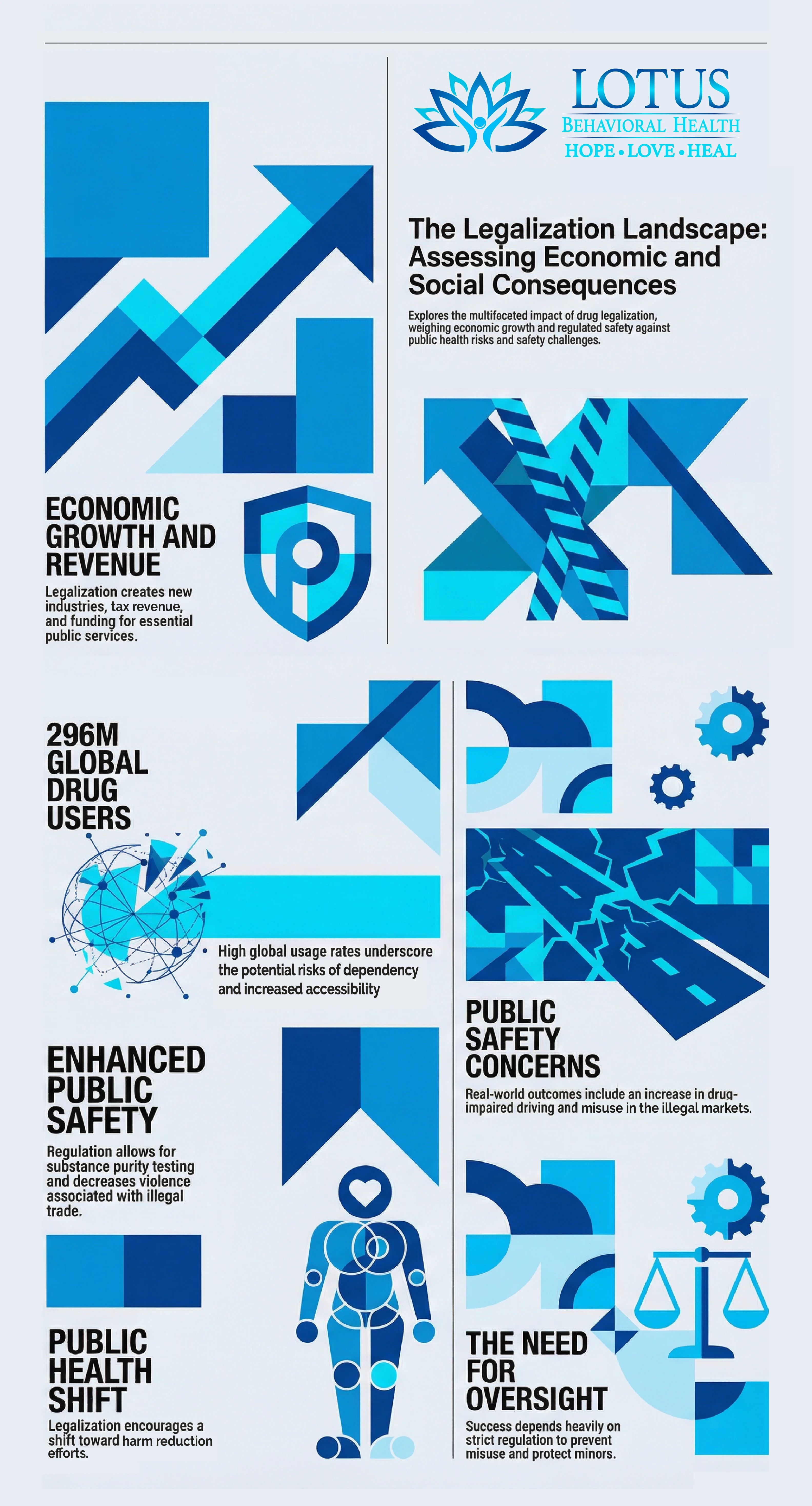
According to the most recent United Nations Office on Drugs and Crime (UNODC) World Drug Report, an estimated 296 million people worldwide used drugs in 2021, with cannabis remaining the most widely used substance.
Cannabis use alone is estimated at over 219 million people globally, representing roughly 4% of the world’s adult population. This marks a substantial increase from the 192 million reported in 2016, reflecting both population growth and expanding markets in regions that have legalized or decriminalized use [5].
Recent estimates also suggest that more than 22–24 million people globally live with cannabis use disorder, with prevalence highest among teens and young adults. As legalization expands, researchers are closely monitoring how policy changes influence frequency of use, potency exposure, and treatment demand [6].
Risks and Societal Impacts
The potential public health risks and societal impacts of drug legalization cannot be ignored. The debate over whether drugs should be legalized is one that requires a careful and thorough examination of all aspects, including public health, societal norms, crime rates, and international perspectives.
International Perspectives
The debate around 'should drugs be legalized?' isn't confined to the United States. Different parts of the world adopt different approaches, with European countries often taking a starkly contrasting stance compared to the US. This section will discuss the European approach to drug policy and contrast it with the US policies.
European Approach to Drug Policy
The legalization and decriminalization of drugs continue to shape social norms across multiple countries. While the Netherlands has tolerated retail cannabis sales in licensed coffeeshops since 1976, recent reforms have moved beyond tolerance toward regulated supply chains.
In 2023, the Dutch government launched a controlled cannabis supply experiment to address the long-standing “backdoor problem,” where cannabis was sold legally but sourced illegally. Meanwhile, broader cannabis legalization has expanded globally [7].
Comparison with US Policies
Contrasting the European policy with the North American scenario, it's noticeable that the legalization of cannabis in certain areas has had mixed results. For instance, in Canada, despite the intention to reduce illicit cannabis sales, the black market for cannabis actually increased with legalization, as more marijuana became available from legal sources to sell illegally.
In the fourth quarter of 2018, 79% of cannabis in Canada was bought illegally. Similarly, in California, despite the legalization of cannabis in 2016, as much as 80% of all cannabis sales are linked to illegal sources.
However, there were positive impacts too. Following its legalization in Canada, cannabis-related drug offences made up a much smaller proportion of all drug offences; less than one-fifth compared to a little over two-thirds prior to legalization. There was an 85% decrease in the rate of adults charged with cannabis-related offences since before the legalization of cannabis (2017), and a similar decrease of 87% among the youth [8].
However, it should be noted that the rate of drug-impaired driving offences increased by 105% from 2017 to 2020 in Canada as a response to Criminal Code amendments following cannabis legalization.
Furthermore, data from 2020 shows that cannabis-related drug offences in Canada accounted for just 19% of all drug offences reported by police — the lowest proportion since 1986. This dramatic reduction underscores how legalization, when paired with consistent enforcement and public health messaging, can shift criminal activity patterns. However, the rate of drug-impaired driving offences increased by 105% from 2017 to 2020, highlighting that legalization without strong public safety guardrails can introduce new risks that must be actively managed.
Impact of Legalization
One key aspect of the 'should drugs be legalized?' debate revolves around the impact of such legalization on crime rates, law enforcement, and wider health and social outcomes. This section will delve into the observed and potential consequences of drug legalization.
Crime Rates and Law Enforcement
Legalizing drugs can lead to a decrease in drug-related crimes as the illicit market diminishes and quality control measures are implemented. This process undermines the illegal drug market, potentially reducing drug-related violence and criminal activities associated with the illicit drug trade, as people can legally purchase drugs, lowering the demand for black-market substances.
Legalizing drugs can lead to a decrease in drug-related arrests, freeing up law enforcement resources to focus on other serious crimes. For example, California, which legalized medical marijuana in 1996 and recreational marijuana in 2016, saw a significant reduction in drug-related arrests [8].
Health and Social Outcomes
When drugs are legalized and regulated, health systems can shift from punishment to prevention and care. A legal framework can reduce harms tied to an unregulated supply—like unknown potency, contamination (e.g., fentanyl-adulterated products), and inconsistent dosing by enabling quality controls, clear labeling, and safer access.
It can also expand access to treatment and harm-reduction services (screening, counseling, medication-assisted treatment, and overdose prevention), and reduce stigma so more people seek help earlier.
At the same time, legalization can carry real risks if commercialization outpaces public health. Greater availability and normalization may increase initiation, heavy use, or dependency in some groups, especially adolescents and people with underlying mental-health conditions—unless policy is strict and enforcement is consistent.
Drug Policy Education and Teen Addiction Treatment in Florida
Lotus Behavioral Health helps teens and families across Florida with evidence-based addiction and mental health treatment, while keeping parents informed on current drug trends, emerging substances, and shifting legal efforts that can impact teen safety.
If you’re worried about your teen’s use, or you simply want clear guidance on what’s happening right now in the legal and public health landscape, reach out today to schedule a confidential assessment. Find support that meets your family where you are.
Sources
[1] Miron, J. 2018. The Budgetary Effects of Ending Drug Prohibition. CATO Institute.
[2] Gibson, S. et al. 2023. Multidisciplinary argument for the decriminalization of drugs. Wiley Online Library.
[3] Chand K. Should drugs be decriminalised? Yes. BMJ. 2007 Nov 10;335(7627):966. doi: 10.1136/bmj.
[4] Yakowicz, W. et al. 2026. Where Is Cannabis Legal? A Guide To All 50 States. Forbes.
[5] United Nations Office on Drugs and Crime. World Drug Report 2025.
[6] Antony, C. et al. 2026. Global burden of amphetamine, cannabis, cocaine, and opioid use in 204 countries, 1990–2023: a Global Burden of Disease Study. IHME.
[7] Grund, J. Et al. 2013. Coffee Shops and Compromise. Open Society Foundations.
[8] Lange, T . 2025. 60% of Cannabis Consumed in California Comes From Unregulated Market as Licensed Production Grows. Cannabis Business Times.
About the Author





.svg)



Hours
Accreditations