
Can Teens Continue School While Attending Addiction Treatment?
Yes, teens can keep up with school during addiction treatment. Learn how credits transfer, how IOP protects enrollment, and what to ask before you enroll.

One of the first questions parents ask when they realize their teenager needs treatment is a practical one: what happens to school?
It is a fair question. Missing significant time from class, falling behind on credits, and disconnecting from peers can feel like consequences that ripple long after treatment ends. And for a lot of families, the fear of academic fallout becomes one of the reasons treatment keeps getting delayed.
Here is what parents need to know: the right treatment program does not ask your teen to choose between getting well and staying on track academically. It builds both into the same structure.
How Does Substance Use Affect a Teen's Academic Performance?
Teens who use substances regularly are significantly more likely to have higher rates of school absenteeism, lower grades, and reduced engagement with learning [1].
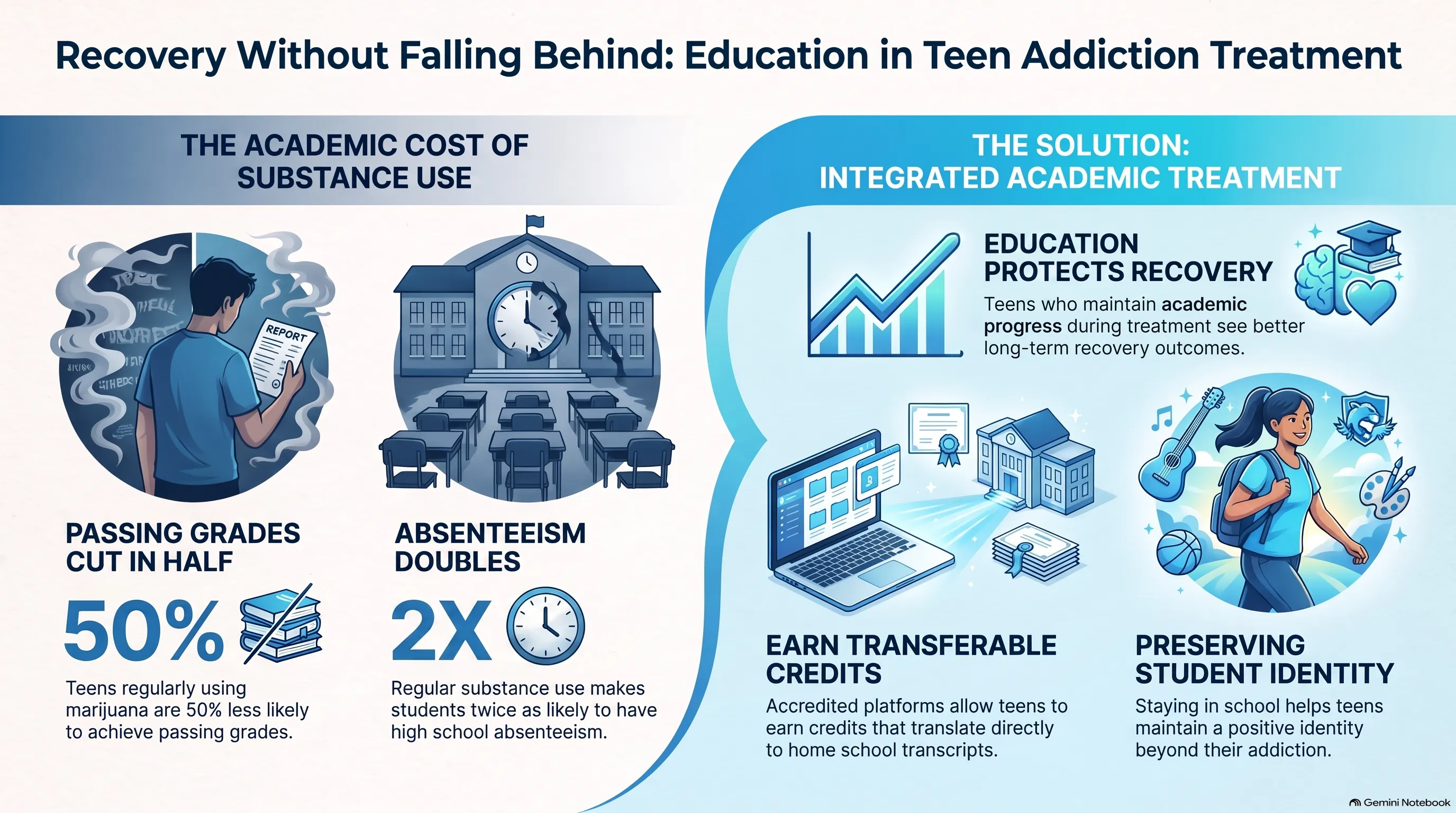
A review of teen substance use and academic outcomes found that students who regularly used marijuana were about half as likely as non-users to achieve passing grades and twice as likely to have high absenteeism [2].
Research following more than 1,000 teens through substance use treatment found that reductions in substance use were directly associated with improved school attendance in the months that followed [3].
What Happens to School When a Teen Enters Residential Treatment?
A high-quality teen addiction program should include an academic component as part of the daily structure. The research on adolescent treatment outcomes consistently points to educational engagement as a protective factor in recovery, meaning teens who maintain some connection to academic progress during treatment tend to do better after discharge than those who are completely disconnected from it [4].
Keeping academic life alive during residential treatment also preserves something psychologically important: a sense of identity beyond the treatment experience. Your teen is not just a person in treatment; they are students.
Can Teens Keep Their Credits While in Treatment?
Programs that partner with accredited platforms can offer coursework that counts directly toward a teen's home school graduation requirements. This means a teen who spends 30 to 60 days in residential treatment does not have to return to school a full semester or year behind. Credits earned during treatment translate back to their transcript.
This requires coordination between the treatment program, the online academic platform, and the home school. It also requires a point of contact on the treatment side, such as an academic coordinator, who manages that relationship and ensures the handoff at discharge is smooth.
Not every program has that infrastructure. For families exploring treatment options, it is worth asking specifically whether academic credits earned during treatment will transfer to the home school and what documentation the program provides to support that process.
What About Teens in Outpatient Treatment? Do They Have to Drop Out of School?
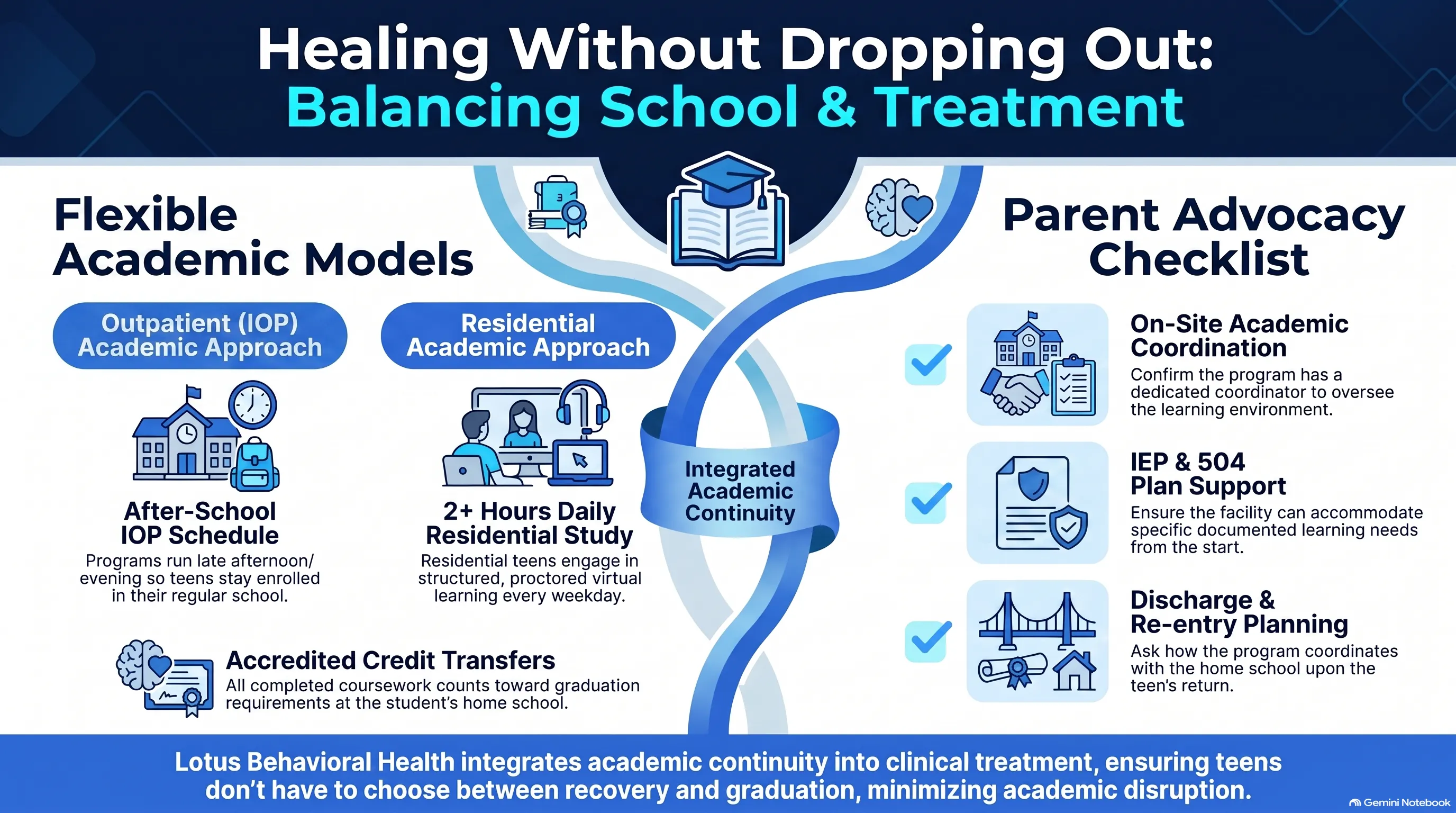
For teens in an intensive outpatient program, the entire model is built around keeping school intact. IOP typically runs after school hours so teens can remain enrolled in their regular school, maintain their friendships and daily routines, and still receive focused clinical treatment multiple days a week.
The goal is not to pull a teen out of their life. It is to add a structured layer of support while they stay in it. This matters because peer connection, academic engagement, and daily routine are all factors that support recovery. Removing them entirely creates its own set of risks.
What Should Parents Ask About Academics When Evaluating a Program?
Not every treatment program handles academics the same way. Before enrolling your teen, these are the questions worth asking directly:
- Do you have an on-site academic coordinator?
- What online platform do you use, and is it accredited?
- Will credits earned during treatment count toward my teen's home school graduation requirements?
- How do you coordinate with the home school at discharge?
- Can you accommodate my teen's IEP or 504 plan?
- For outpatient treatment, what are the hours, and will my teen be able to stay enrolled in their regular school?
How Lotus Behavioral Health Handles School: Our Academics Program
At Lotus Behavioral Health, academic continuity is treated as a clinical priority, not an afterthought. For teens in the residential program, Lotus partners with a third-party online academic platform that provides a self-paced, proctored virtual learning environment.
Each teen has access to their own computer during academic time, and an on-site academic coordinator oversees the learning environment with support from behavioral health technicians. A minimum of two hours per day is dedicated to structured academics, with additional time available based on each student's needs and workload.
All coursework completed through the Lotus academic program is approved for academic credit and counts toward a teen's graduation requirements at their home school. Coordination with the home school is handled on a case-by-case basis, and families are encouraged to share relevant IEP or 504 plan documentation during the admissions process so accommodations can be built in from the start.
For teens in the Lotus IOP, the schedule is designed specifically around the school day. IOP runs Tuesday through Thursday in the late afternoon and early evening, which means teens can remain fully enrolled in their regular school during treatment.
The goal at every level of care is the same: your teen should leave Lotus not just healthier but positioned to re-enter their academic life with as little disruption as possible.
A Note for Florida Families
In Florida, teens receiving treatment are protected from academic penalty by the McKay Scholarship Program and other educational provisions that support students with documented disabilities.
Families navigating both treatment and education simultaneously should ask their child's school counselor about their rights and options before and during treatment and should request in writing how the home school plans to handle credit transfers and attendance.
Lotus's admissions team can also help Florida families understand what to expect and what questions to ask their school district before the teen's first day of treatment.

Sources:
[1] Balsa, A. I., et al. (2011). Substance use and academic outcomes among high school seniors. PMC, National Library of Medicine.
[2] Nash, A. (2025). The landscape of substance use in youth. Journal of Pediatric Health Care.
[3] Engberg, J., & Morral, A. R. (2006). Reducing substance use improves adolescents' school attendance. Addiction, 101(12), 1741–1751.
[4] UNODC and WHO Informal Scientific Network. (2024). Prevention, treatment and care of substance use disorders among adolescents. PMC, National Library of Medicine.
About the Author




.svg)



Hours
Accreditations


.png)