
Places Where Teens Hide Drugs: Insights for Parents
Learn where teens hide drugs and vapes, the warning signs that matter more than hiding spots, and how to talk to your teen. Find support for Florida families.
.webp)
Most teens are not using substances, and teen drug use is actually at a historic low [1]. But for the ones who are using, hiding it has gotten easier, largely because vapes and modern products that contain drugs are small, quiet, and easy to disguise.
This guide walks parents through where substances tend to get hidden and, more importantly, what to watch for and how to respond without turning your home into a search operation.
Teen Drug and Alcohol Use in 2026
Let's start with the good news. Teen substance use is at some of the lowest levels ever recorded. In the 2025 Monitoring the Future survey, 91% of 8th graders, 82% of 10th graders, and 66% of 12th graders reported not using marijuana, alcohol, or nicotine in the past month, and those numbers have held at historic lows for five years running [1].
That said, awareness still matters, especially because the products themselves have changed. A generation ago, hiding a substance meant hiding something bulky or smelly. Today, a vape that contains drugs such as cannabis or nicotine can look like a USB drive or a highlighter, and it leaves little more than a faint, quickly fading scent.
That shift is exactly why some parents feel caught off guard. This is not about paranoia or searching your kid's room like a detective. It is about knowing what is normal, what is worth a second look, and how to open a conversation if something feels off.

Where Do Teens Tend to Hide Substances?
Concealment usually comes down to one principle: blend in with the ordinary. The most effective hiding spots are the ones that look completely unremarkable [2].
Everyday Objects
Common items make convenient hiding places precisely because no one thinks twice about them. A hollowed-out marker, a repurposed makeup container, or a hidden compartment in something that looks like a normal school supply can all serve the purpose.
Vape devices in particular are now designed to resemble everyday objects, including flash drives, pens, and highlighters, which is a big part of why they are so easy to miss.
Bedrooms
The bedroom is the most common territory to hide drugs, simply because it offers the most privacy. Substances or devices may end up tucked behind posters and picture frames, inside empty product packaging, or in the small gaps of furniture.
This is not a cue to tear a room apart. It is context for why a sudden urge to keep a door closed or unusual defensiveness about privacy can be worth gently noting.
Bathrooms
Bathrooms are easy to overlook because they are shared and mundane. Ventilation, the space around fixtures, and ordinary-looking toiletry containers can all become hiding spots, and the bathroom fan or an open window offers a quick way to clear the air.
Vehicles and Bags
For teens who drive, cars offer plenty of small, routinely used spaces that rarely get a second glance. The same goes for backpacks and everyday bags, where something small can disappear among school supplies.
Disguised "Stash" Products
There is an entire market of products designed specifically for concealment: containers made to look like soda cans, everyday toiletries, or food items, often with hidden compartments. They are marketed openly and easy to find.
The goal here is not to memorize a checklist and go hunting. It is to understand the general logic that concealment relies on looking normal, so your awareness is grounded in reality rather than fear.
What Actually Matters More Than Hiding Spots: Signs of Drug Use in Teens
Where a substance is hidden matters far less than the changes you notice in your teen. Physical objects are easy to move. Behavioral patterns are much harder to fake over time, and they tell you more.
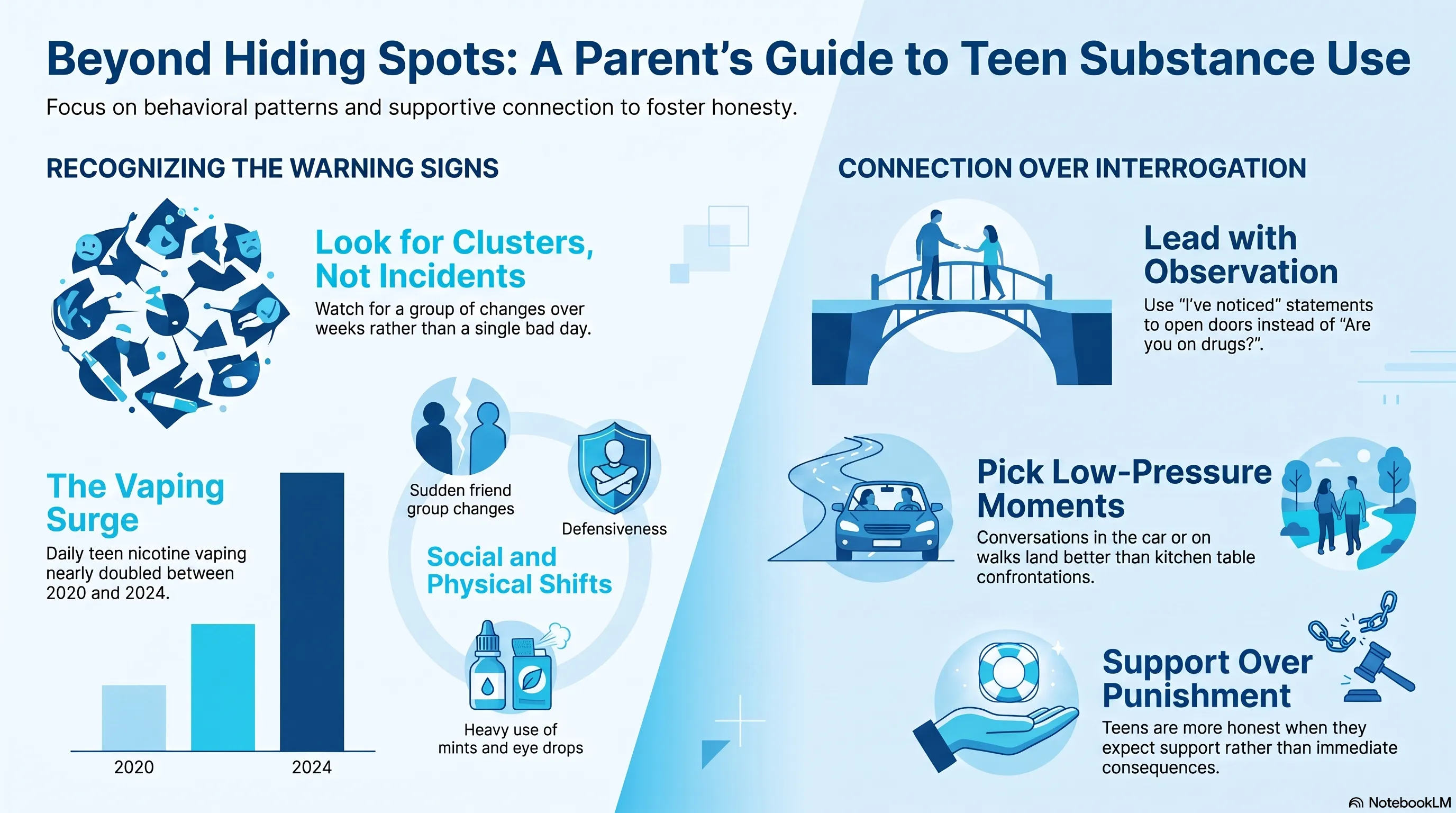
Warning signs worth paying attention to include [3]:
- A sudden shift in friend groups, especially paired with secrecy about who they are with
- New or increased defensiveness, irritability, or withdrawal from family
- A drop in grades or loss of interest in activities they used to care about
- Changes in sleep, energy, or appetite that do not have an obvious explanation
- A sudden uptick in cover-ups, like heavy use of body spray, mints, gum, or eye drops
- Money or valuables going missing, or vague explanations about spending
No single one of these confirms anything. Teenagers are moody, private, and experience mood shifts by nature; that is normal development. What matters is a cluster of changes that build over weeks, rather than one bad Tuesday.
What to Do If You're Concerned About Teen Drug Use
If the signs are adding up, the instinct to search, confront, and demand answers is understandable. But the research on adolescent behavior is consistent: connection works better than interrogation [4].
Lead with observation, not accusation. "I've noticed you've seemed really tired and withdrawn lately, and I care about you" opens a door. "Are you on drugs?" slams it shut.
Pick a low-pressure moment. A conversation in the car or on a walk tends to land better than a face-to-face confrontation at the kitchen table.
Stay curious and listen. Teens disengage the second a conversation becomes a lecture. The goal is to keep them talking, even when what they say is hard to hear.
Make your home a safe place to be honest. Teens who believe they will be met with support rather than punishment are far more likely to come to their parents when something is wrong.
Know the signs of what they may be using. Vaping, in particular, is worth understanding, because daily nicotine vaping among teens who vape nearly doubled between 2020 and 2024, and more than half of daily vapers who tried to quit were unable to [5].
When to Seek Professional Support: Teen Substance Use Treatment in Florida
Trust your instincts. If the patterns are stacking up or you’ve found something and don’t know what to do next, you don’t have to navigate it alone. Early support is far more effective than waiting for a crisis, and reaching out does not mean things have gone too far. Often it means you caught something early enough to change its course.
At Lotus Behavioral Health, we work with teens ages 12 to 17 and their families across the Orlando area. Sometimes that means a structured treatment program. Just as often, it starts with an honest conversation about what is going on and what your family needs. We treat substance use alongside the anxiety, depression, or trauma that so frequently sits underneath it because reaching a teen means seeing the whole picture.
If something feels off, be curious about it, and reach out. We're here to help you figure out what comes next.

Sources
[1] Oster, R. 2025. Monitoring the Future survey: Teen substance use remains low in 2025. Partnership to End Addiction.
[2] Cassada, R. Secret Stash: Ten Most Common Places Teens Hide Drugs. Psychology Today.
[3] Zeng, Q. (2011). Early detection of illicit drug use in teenagers. Innovations in clinical neuroscience, 8(12), 24–28.
[4] Dweck, C. S. (2018). Why Interventions to Influence Adolescent Behavior Often Fail but Could Succeed. Perspectives on psychological science: a journal of the Association for Psychological Science, 13(1), 101–122.
[5] Bae, D. et al. 2025. Among youth who vape, USC study finds rise in daily use and difficulty quitting. Keck School of Medicine USC.
About the Author




.svg)



Hours
Accreditations



.png)