
What Is "Robo-Tripping"?
Robo-tripping is teen misuse of DXM cough medicine to get high. Learn the risks, warning signs, and how to talk to your teen, plus where to find support.
.webp)
If you have seen the term "robo-tripping" pop up in a school newsletter or a worried parenting group online, you are not imagining a new trend. It is old, it has a real medical basis, and it is worth understanding clearly instead of reacting to headlines alone.
Robo-tripping is the slang term for intentionally taking large doses of over-the-counter cough medicine, specifically ones containing dextromethorphan, or DXM, to get high. At normal doses, DXM is a safe and effective cough suppressant found in products like Robitussin, which is where the name comes from.
At very high doses, DXM produces dissociative effects similar to drugs like ketamine or PCP. Robo-tripping isn't a new trend, but because cough medicine is cheap, legal, and sitting in most bathroom cabinets, it flies under most parents’ radar.
What Is Robo-Tripping?
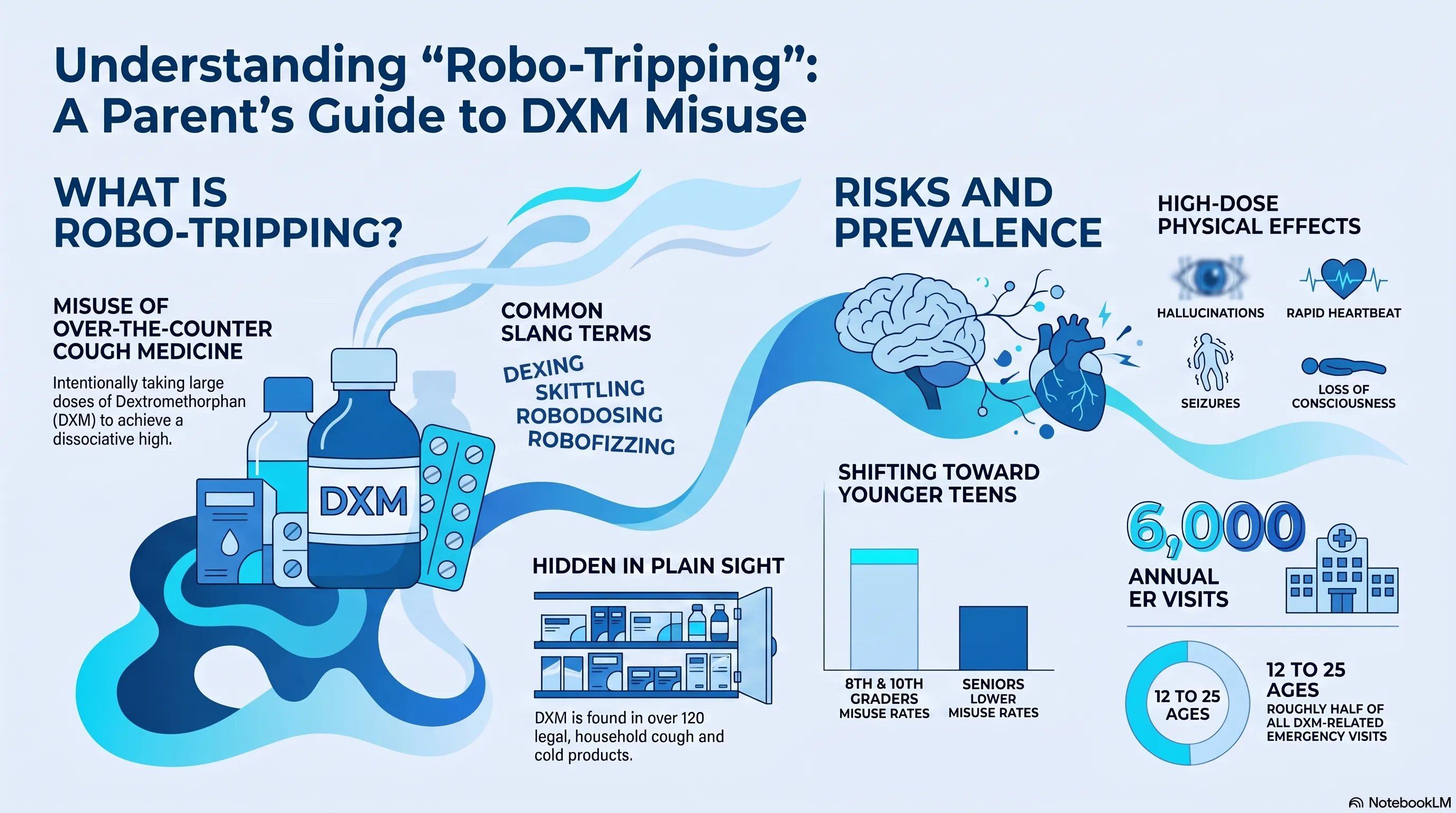
Robo-tripping refers to intentionally taking a much higher-than-recommended dose of dextromethorphan, or DXM, the cough-suppressing ingredient found in more than 120 over-the-counter cough and cold products.
At normal doses, DXM is considered safe and effective. At high doses, it produces a dissociative high that can include altered time perception, visual hallucinations, and an out-of-body feeling, along with far less pleasant effects such as agitation, rapid heartbeat, and, in serious cases, seizures or loss of consciousness [1].
Do Teens Actually Use the Term "Robo-Tripping"?
Yes, though it is one of several names for the same behavior. The term comes from Robitussin, one of the most recognizable cough syrup brands, combined with "tripping."
Teens and clinicians also use "dexing" and "skittling" for the Coricidin tablet version, as well as less common terms such as "robodosing" or "robofizzing" [1]. If a parent hears any of these terms, they all point to the same underlying behavior, so it is worth learning them rather than assuming an unfamiliar word is nothing to worry about.
How Common Is Robo-Tripping Among Teens Right Now?
Less common than it was two decades ago but still present and shifting toward younger teens. The Monitoring the Future survey, conducted annually by the University of Michigan and funded by the National Institute on Drug Abuse, found that cough and cold medicine misuse peaked in 2006, when 6.9% of 12th graders reported abusing it in the past year.
In the most recent 2025 data, that number was down to 3.1% among 12th graders, while 8th graders came in at 4.2% and 10th graders at 5.1%, making younger teens the group researchers are watching most closely [2].
That shift matters because middle schoolers generally have less awareness of dosing risk than older teens. Cough and cold medicine is also easy to access without anyone noticing, sitting in a home medicine cabinet rather than requiring a purchase from someone willing to sell to a minor. Nationally, DXM abuse still accounts for roughly 6,000 emergency room visits a year, about half of them among people aged 12 to 25 [1].
Is This a Real Danger, or Just an Overhyped Internet Scare?
It is a real, documented risk, though not a brand-new one manufactured by social media. DXM abuse has been tracked by poison control centers and the FDA since long before TikTok existed, including an FDA warning in 2005 following reports of teen deaths tied to concentrated DXM powder purchased online [1][3].
What has changed is visibility. Teens now post about their experiences online, which makes the behavior easier for outsiders to stumble upon and mistake for a brand-new fad. It spreads more through anonymous videos and peer conversation, which makes it harder to track and harder for parents to dismiss as a passing internet joke.
What Makes Robo-Tripping More Dangerous Than It Sounds?
Part of what makes robo-tripping riskier than many teens realize is that there is no reliable way to dose it safely once someone is intentionally exceeding the label.
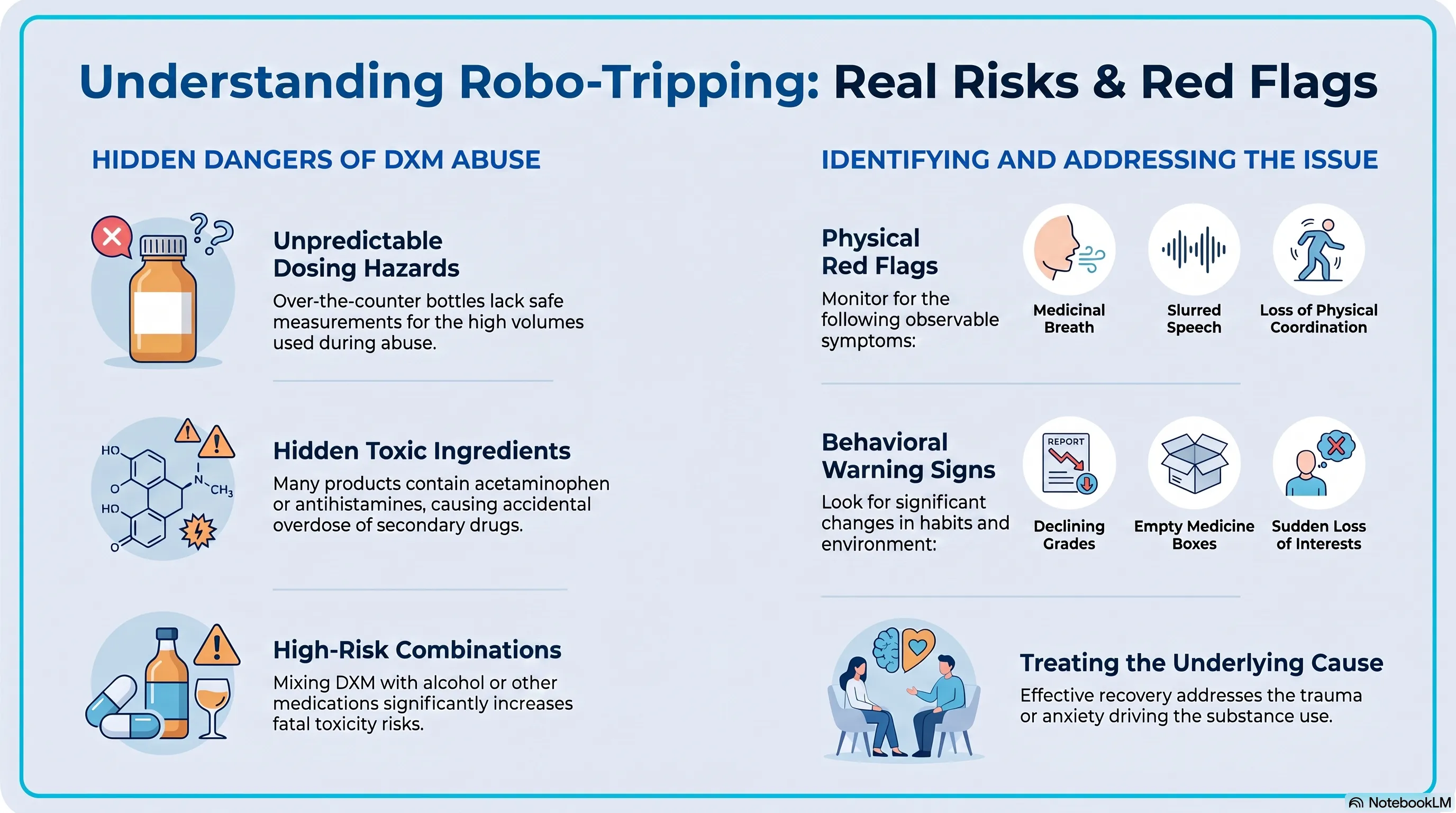
A cough syrup bottle is not designed to be measured out in the quantities needed to get high, and many combination products also contain acetaminophen or antihistamines, so a teen chasing a specific effect can unintentionally take a toxic dose of an entirely different ingredient at the same time.
Poison control centers have documented fatal cases involving teens who ordered concentrated DXM powder online and misjudged the dose entirely, since powder offers none of the built-in dosing limits of a bottle or a blister pack [1]. Mixing DXM with alcohol or other medications raises the danger further, since the combination can be far more toxic than either substance on its own [1].
What Should Parents Watch For?
The warning signs are practical and easy to miss if you are not looking for them:
- Empty cough or cold medicine boxes
- A chemical or medicinal smell regularly coming from teens’ breath
- Declining grades
- Sudden loss of interest in activities your teen used to enjoy
- Slurred speech or a loss of coordination that resembles intoxication without any smell of alcohol [1]
None of these signs alone is proof of anything, but a pattern of them is worth a direct, calm conversation rather than a search through their room.
Drug Use & Mental Health Treatment for Teens in Florida
Lotus Behavioral Health does not treat robo-tripping as an isolated, one-off problem to lecture a teen out of. Whether a teen is misusing an over-the-counter cough medicine, a prescription, or anything else, the clinical team looks for what is underneath the behavior, since teen substance use is frequently tied to unaddressed trauma, anxiety, or other mental health struggles rather than simple curiosity.
Treatment focuses on the underlying issue alongside the substance use itself, so a teen leaves with more than just a reason to avoid cough syrup. They leave with an actual plan for the stress or pain that led them there in the first place.
Robo-tripping is not a myth, nor is it a modern invention. It is an old problem that occasionally resurfaces in a new form. If you are concerned about whether your teen is struggling with drug and alcohol use, contact our admissions team today and let us support your family.

Sources
[1] National Capital Poison Center. Dextromethorphan abuse. poison.org.
[2] Stop Medicine Abuse. Teen self-reported abuse of OTC cough/cold medicines remains low. Data from the University of Michigan Monitoring the Future survey. stopmedicineabuse.org.
[3] Gershman, J.A. et al. Dextromethorphan: A case study on addressing abuse of a safe and effective drug. ncbi.nlm.nih.gov.
About the Author



.svg)



Hours
Accreditations



.png)