
What Should I Look for in a Residential Treatment Program for Teens?
Choosing teen residential treatment? Learn the clinical, family, and accreditation standards that actually predict recovery, plus the questions to ask.

Choosing a treatment program for your teenager when they are already in crisis is one of the most difficult decisions you will make as a parent. The options can feel overwhelming, the language is often clinical and hard to understand, and the stakes feel impossibly high.
Most parents are making this decision during one of the most stressful periods of their lives, without a clear guide for what actually matters. Here is what the research and clinical experience say you should actually be looking for and the questions worth asking before you commit.
Does the Program Treat Mental Health Alongside Addiction?
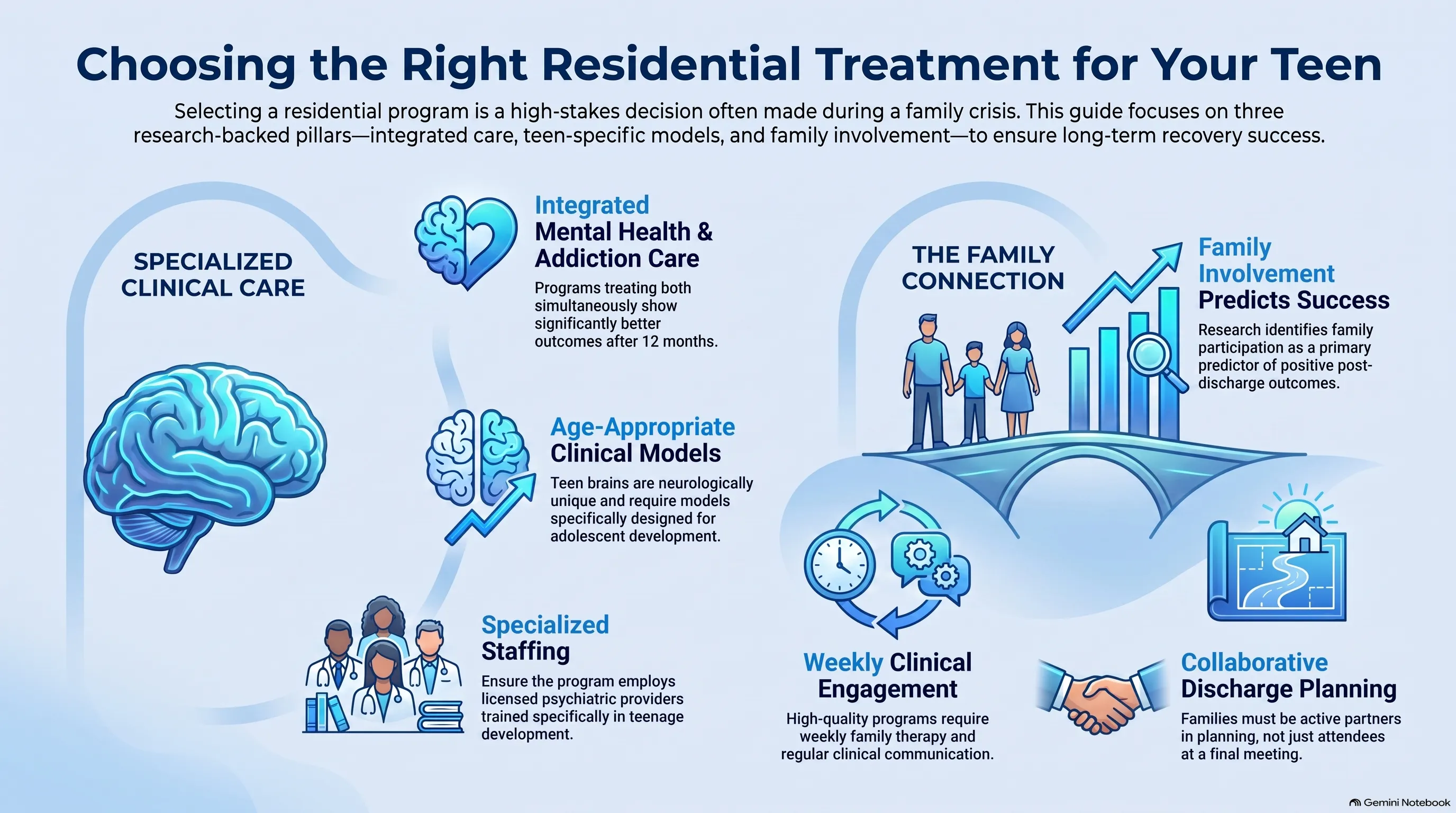
Research shows that teens attending treatment facilities that offer integrated mental health services had much better outcomes at 12 months than teens attending facilities that offered no such services [1].
For most teenagers in treatment, the drug and alcohol use is not the whole story. Anxiety, depression, trauma, ADHD, and other mental health conditions are almost always part of the picture, and treating the addiction without addressing what is underneath it produces incomplete results.
When looking for a program, ask directly: do you have a licensed psychiatric provider on staff, and are mental health conditions treated simultaneously with substance use?
Is the Program Specifically Designed for Teens?
Teen brains are neurologically different from adult brains, and adolescent substance use presents differently, progresses differently, and responds to treatment differently than adult substance use [2].
A program built around teen-specific treatment models will approach things like peer dynamics, family involvement, academics, and developmental stages differently from a program that treats teenagers just using an adapted adult model.
- Ask whether the program's clinical staff are trained in teenage development
- Ask whether the therapies used have been studied with teenage populations
- Ask whether the program treats only teens or mixes them with adults
How Is Family Involved in the Treatment Process?
Family involvement is not a bonus feature in teen residential treatment. It is a clinical necessity. Research on residential treatment outcomes consistently identifies family and aftercare involvement as two of the strongest predictors of positive post-discharge outcomes [3].
Programs that do not actively involve families in the treatment process are missing one of the most powerful protective factors available.
What family involvement should actually look like:
- Weekly family therapy sessions
- Regular clinical communication about your teen's progress and any medication or treatment plan changes
- Active inclusion in discharge planning
- Structured family education
What it should not look like: an occasional family day or a single discharge meeting. If a program cannot tell you specifically how often families participate in therapy and what that participation involves, that is worth looking into further.
What Does a Typical Day Look Like, and How Much Clinical Time Does My Teen Receive?
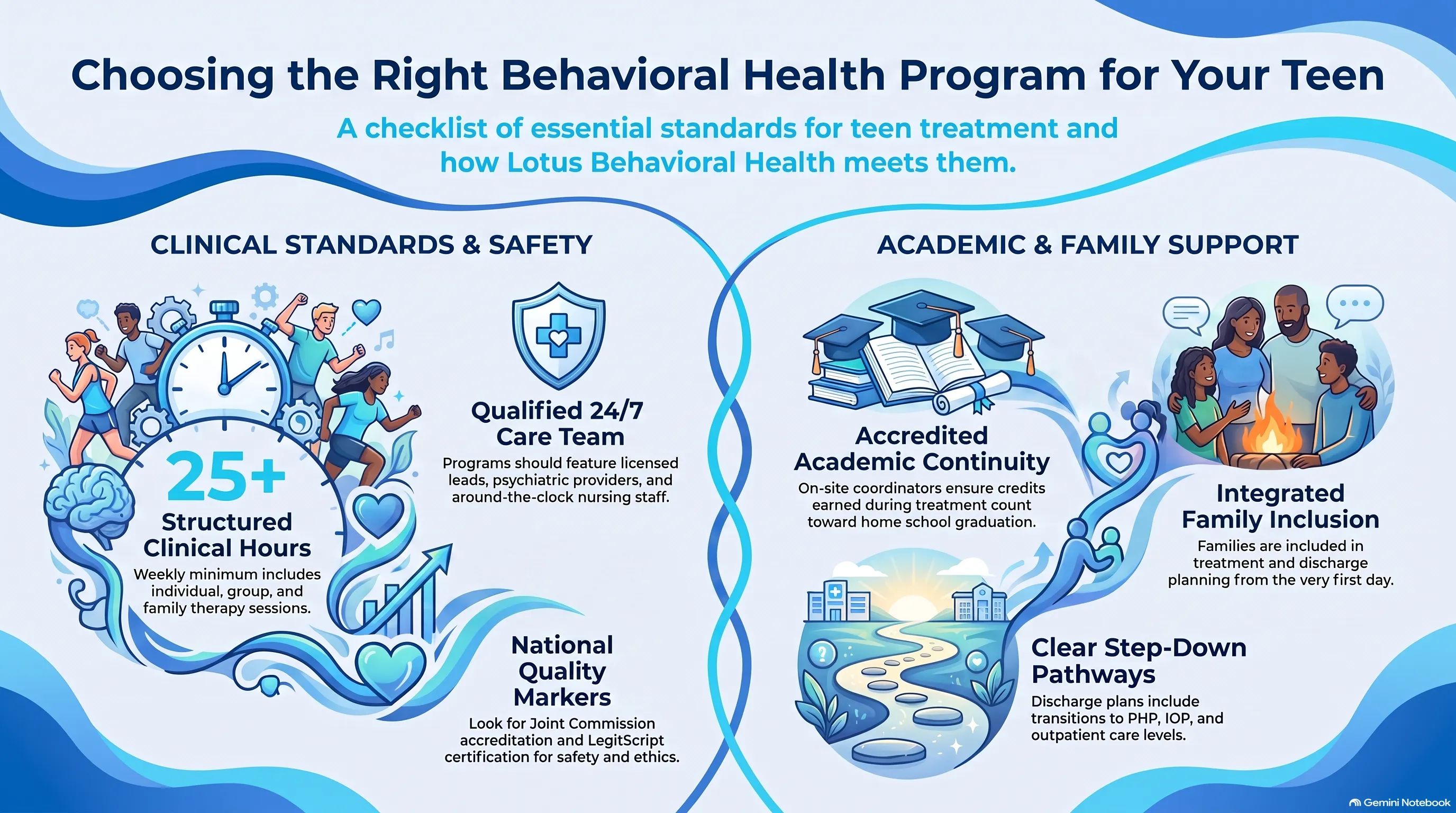
A minimum to look for is 25 structured hours of therapy and programming per week. That includes individual therapy, group therapy, skills-based programming, and family sessions, not administrative time, free time, or recreation counted as clinical hours [4].
- Ask for a sample daily schedule
- Ask how many individual therapy sessions your teen will receive per week and with whom
- Ask how many group therapy sessions run each week and what the topics or focus areas are
- Ask whether family therapy is included in the weekly clinical hours or scheduled separately
- Ask how the program tracks clinical progress and how often the treatment plan is reviewed and updated
What About Staff Qualifications and Ratios?
The people delivering care are as important as the model being used to deliver it. Research on positive treatment outcomes found that staff training, credentials, and consistency all deeply affect patient outcomes [4].
Some things to ask about staff and qualifications include:
- What is the staff-to-teen ratio during waking hours and overnight?
- Are staff awake and actively on shift overnight, or do they sleep on-site?
- Is a nurse on-site around the clock?
- What credentials does the clinical lead hold?
- How is contraband screened, and what protocols exist for behavioral emergencies?
What Happens With School While My Teen Is In Treatment?
For most families, academics and wondering how their teens will keep their grades up is a genuine concern.
Look for programs that partner with an accredited online academic platform, have an on-site academic coordinator, and can confirm that credits earned during treatment will count toward your teen's home school graduation requirements.
Ask specifically how IEPs and 504 plans are accommodated and what the process looks like for coordinating with the home school at discharge.
Is the Program Accredited?
Joint Commission accreditation and LegitScript certification are two markers that a program has been reviewed against national standards for clinical care, safety, and ethical business practices.
Also consider asking whether the program is listed with SAMHSA's Treatment Locator, which requires programs to meet basic verification standards.
What Lotus Behavioral Health Offers Florida Families
At Lotus Behavioral Health, teens receive a minimum of 25 structured hours of therapy and programming per week during. Mental health and substance use are treated together by a clinical team that includes a licensed clinical lead, psychiatric provider, nursing staff, behavioral health technicians, and an academic coordinator.
Families are included in treatment planning and discharge planning from the start, and academic credits earned during treatment count toward homeschool graduation requirements. We provide regular communication and discharge planning that includes clear step-down pathways to PHP, IOP, and outpatient care.
Lotus is Joint Commission accredited, LegitScript certified, and accepts most major insurance plans, including Blue Cross Blue Shield, Cigna, Optum, TriCare, UnitedHealthcare, Humana, Aetna, and Bright Health.
If you have questions about whether Lotus is the right fit for your teenager, our admissions team is available to walk you through the program, answer every question on this list, and verify your insurance at no cost.

Sources:
[1] Garner, B. R., et al. (2014). Provision of mental health services as a quality indicator for adolescent substance abuse treatment facilities. Journal of Substance Abuse Treatment, 47(5), 384–392.
[2] King, C., et al. (2024). Adolescent residential addiction treatment in the US: Uneven access, waitlists, and high costs. Health Affairs, 43(1), 64–71.
[3] Hair, H. J. (2005). Outcomes for children and adolescents after residential treatment: A review of research from 1993 to 2003. Journal of Child and Family Studies.
[4] Miles, J., et al. (2021). Association of facility characteristics and substance use disorder outcomes at discharge from residential treatment. Journal of Substance Abuse Treatment, 136, 108664.
[5] Godley, S. H., et al. (2016). Continuing care for adolescents in treatment for substance use disorders. Child and Adolescent Psychiatric Clinics of North America, 25(4), 669–684.
About the Author




.svg)



Hours
Accreditations


.png)