Baker Act vs. Marchman Act for Minors in Florida
Baker Act or Marchman Act for your teen? Learn how each Florida law works for minors, who can initiate it, and what happens next. Support for Florida families.

When a Florida parent is watching their teenager spiral, whether it's a mental health crisis or escalating drug or alcohol use, two legal terms tend to surface fast: the Baker Act and the Marchman Act.
Both are Florida laws that allow for involuntary intervention. Both can feel overwhelming in the moment they're actually needed. But they are not interchangeable, and for minors specifically, the rules, the process, and even who is allowed to act are meaningfully different.
Here's what every Florida parent should understand before they're standing in an ER at midnight trying to make a decision.
What Is the Baker Act in Florida?
The Baker Act, formally Chapter 394 of the Florida Statutes, allows for the involuntary examination of someone believed to have a mental illness who, because of that illness, has refused voluntary care and poses a real risk of serious harm to themselves or others in the near future [1].
It's a mental health law, not an addiction law. It exists to get someone in psychiatric crisis into an evaluation quickly, even if they refuse to go on their own.
What Is the Marchman Act in Florida?
The Marchman Act, Chapter 397 of the Florida Statutes, is Florida's law for involuntary substance abuse assessment and treatment. It applies when someone's substance abuse has impaired them to the point that they've lost the power of self-control around drugs or alcohol and can't recognize their own need for help [3]. Unlike the Baker Act, it's built specifically around addiction, not mental illness, though the two frequently show up together in the same teenager.
How Does the Baker Act Work for Minors in Florida?
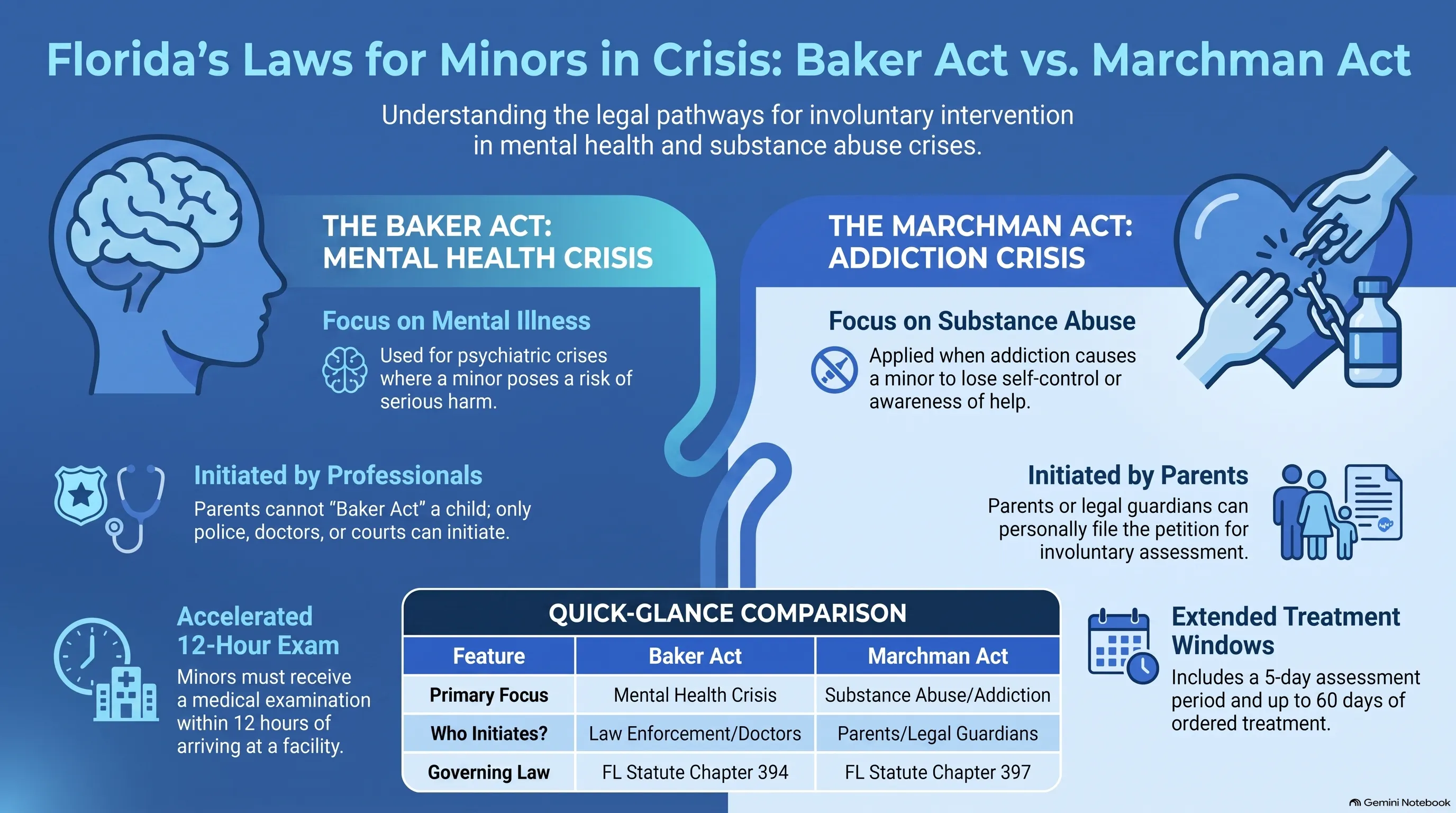
A parent cannot personally decide to "Baker Act" their child. A parent or minor can request or recommend an involuntary examination, but the actual decision has to come from someone with legal authority to initiate it.
This means a law enforcement officer, a circuit court through an ex parte order, or a physician, psychologist, psychiatric nurse, or clinical social worker who has examined the minor within the prior 48 hours [2].
Once initiated, a minor must be examined within 12 hours of arriving at a receiving facility, compared to 72 hours for adults, and must be admitted to a facility specifically licensed to serve minors [2]. Parents must be notified immediately, with follow-up attempts required roughly every hour for the first 12 hours if contact isn't made right away.
A minor cannot be voluntarily admitted unless the parent agrees, the minor agrees, and a court finds the minor competent to consent. Without all three, the minor is treated as involuntary by default. If continued inpatient care is recommended, a minor can be ordered into involuntary placement but often cannot be ordered into involuntary outpatient treatment [2].
How Does the Marchman Act Work for Minors in Florida?
For an adult, almost anyone close to the situation, a spouse, relative, friend, or even a treatment provider, can file the petition for a Marchman Act [4].
However, for a minor, that circle narrows significantly: only a parent, legal guardian, or a licensed service provider can file the petition for involuntary assessment [3]. Under the Marchman Act, a parent genuinely can be the one who sets the process in motion.
Juvenile Marchman Act cases in Florida are typically handled through a county's family court division rather than the standard adult process, and the court appoints an attorney to represent the minor. Involuntary assessment can last up to five days, and if treatment is ordered afterward, it can extend up to 60 days, sometimes longer depending on the county.
What's the Real Difference Between the Baker Act and Marchman Act for Minors?
Strip away the legal language, and the core difference comes down to two things: what's driving the crisis and who gets to act.
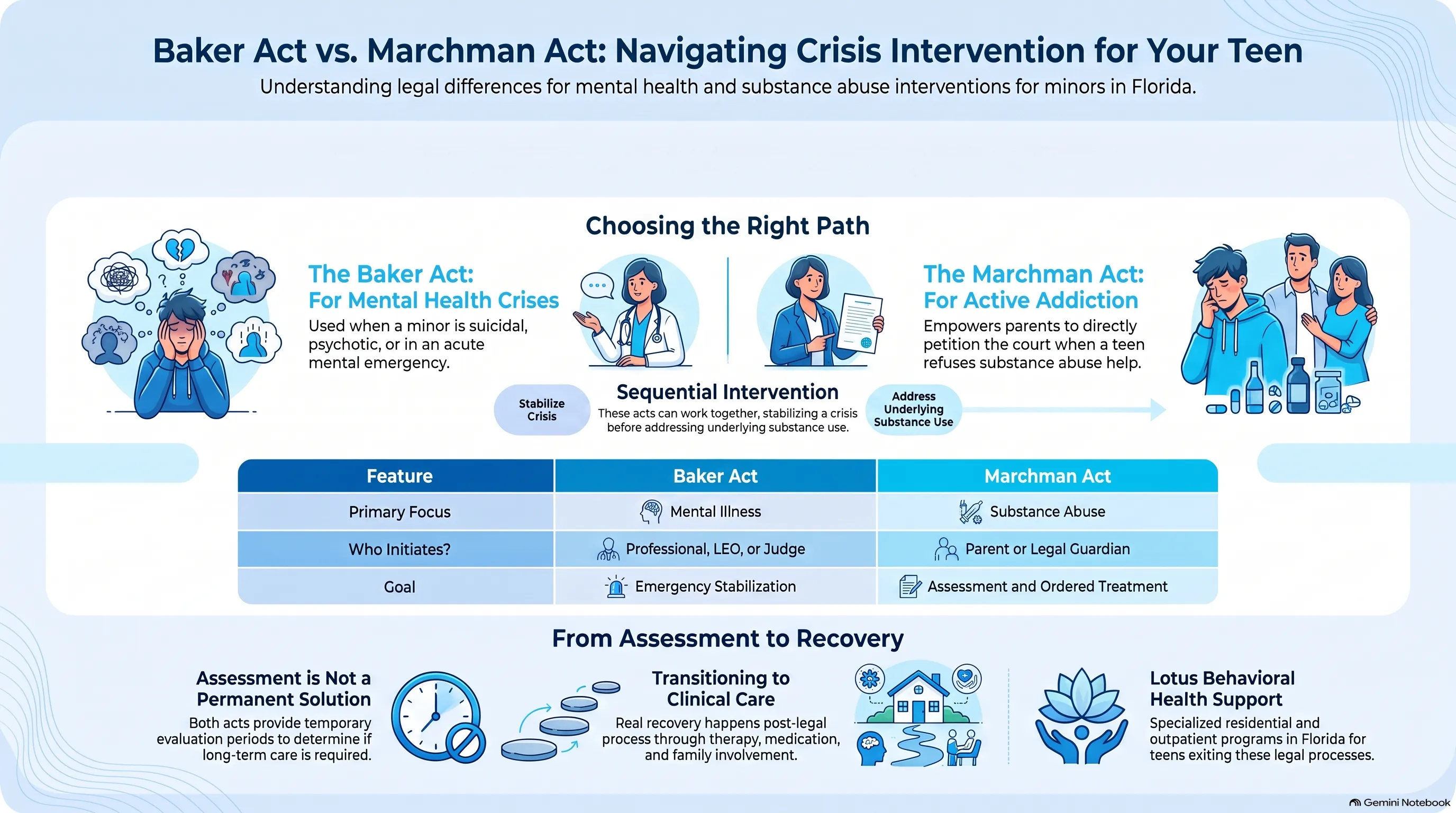
The Baker Act addresses mental illness and requires a professional, law enforcement officer, or judge to make the actual initiation decision, not the parent directly. If your child is suicidal, psychotic, or in an acute mental health crisis, that's Baker Act territory.
The Marchman Act addresses substance abuse, and for minors, a parent or legal guardian can directly petition the court themselves. If your child is caught in active addiction and refusing help, but isn't in a mental health emergency, the Marchman Act is generally the more direct path, because it's one of the few tools that puts real legal authority back in a parent's hands.
Which Legal Path Applies to My Teenager?
Plenty of teenagers don't fall neatly into one category. A teen using substances heavily may also become suicidal. A teen with an untreated mental health condition may self-medicate with drugs or alcohol.
When both are happening, both laws can potentially apply and sometimes are used sequentially: a Baker Act examination to stabilize an acute crisis, followed by a Marchman Act petition to address the underlying substance use once the immediate danger has passed.
The honest answer for most families is that this isn't a decision to make alone. A crisis line, an ER physician, or an adolescent treatment provider can help identify which statute actually fits what's happening.
What Happens After the Examination or Assessment?
Neither act is designed to be a permanent solution. The Baker Act's involuntary examination period is meant to answer one question: does this person need further inpatient care right now?
If not, the minor is released, referred to outpatient care, or moved to voluntary status. If so, a placement petition can extend care for up to six months, reassessed periodically.
The Marchman Act works similarly: the assessment period determines whether ongoing treatment is actually needed, and if so, a judge can order a defined treatment period, not an indefinite one. In both cases, the actual recovery work, therapy, medication management, family involvement, happens after the legal process, not during it [2].
How Lotus Behavioral Health Supports Florida Families Through This
Lotus Behavioral Health is a residential and outpatient treatment center in Winter Springs, Florida, built specifically for teenagers ages 12 to 17 dealing with mental health conditions, substance use, or both at once [5].
For families coming out of a Baker Act examination or a Marchman Act assessment, the hardest question is usually "what happens now." Lotus offers residential treatment, a teen partial hospitalization program, intensive outpatient care, and standard outpatient services, so a teenager can step into whichever level of care actually matches where they are once the legal process ends.
Our clinical teams use evidence-based approaches like CBT, DBT, and EMDR and work directly with families throughout treatment, not just with the teenager alone. If your family is working through a Baker Act or Marchman Act situation and isn't sure what comes next, Lotus Behavioral Health's admissions team can help you figure out the right next step.

Sources
[1] Florida Department of Children and Families. Baker Act Involuntary Examination: Criteria, Processes and Timeframes.
[2] Florida Certification Board. Frequently Asked Questions: Minors, Chapter 394, Florida Statutes – The Baker Act.
[3] Florida Department of Children and Families. Marchman Act.
[4] Eleventh Judicial Circuit of Florida. Marchman Act.
About the Author




.svg)



Hours
Accreditations